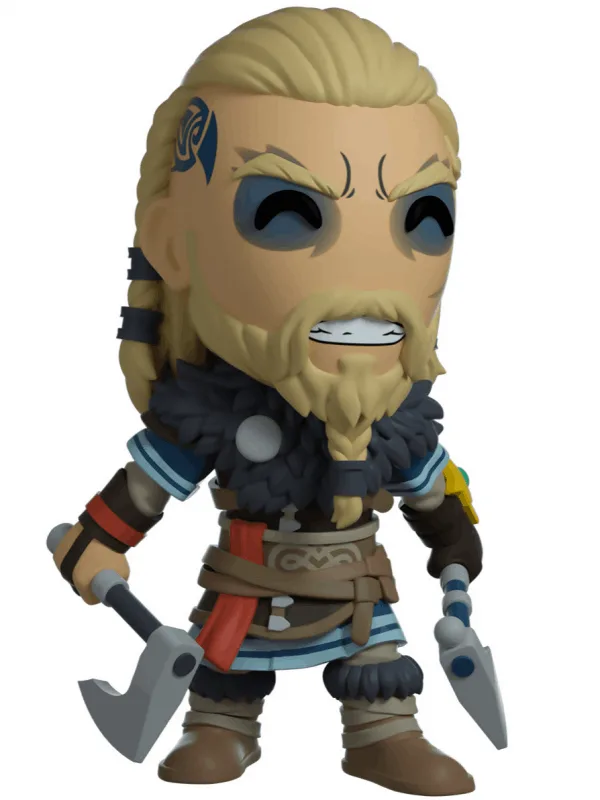
Assassin’s Creed Odyssey (Assassin’s Creed Odyssey review) came out in October 2018 from Ubisoft Quebec and still belongs among the biggest open-world RPGs in the series. I am writing this assassins creed odyssey review after more than 300 hours, mostly as Alexios. The verdict is clear: it is worth playing, especially when you enjoy combat and exploration. I would skip one hundred percent of the map though.
Game info
Assassin’s Creed Odyssey is an action RPG from a third-person view with an open world, stealth, and naval battles. You play as misthios Alexios or Kassandra in ancient Greece in 431 BC, at the start of the Peloponnesian War between Sparta and Athens.
The world is split into mainland, islands, and sea. Between regions you travel on foot, on horseback, or on the ship Adrestia. You pick up quests from the journal, from NPCs, and from icons on the map. The main line runs through family, war, and the Cult of Kosmos. Side content fills forts, camps, tombs, and random events.
The game launched on PC, PlayStation 4, and Xbox One. Today you can get it on Steam, in the Ubisoft Store, or in bundles with the Season Pass. The whole story so that you keep up with leveling takes roughly 40 to 60 hours. With map cleanup and DLC it easily goes over a hundred hours.
What the game offers
The biggest draw is ancient Greece as a huge playground. Island landscape, Athens, Sparta, naval battles, and fortress conquests keep the series atmosphere in one playthrough.
The second strong side is the RPG layer. You level abilities, tune armor, hire a crew, and decide about family. The main threat is the Cult of Kosmos, which pulls the line across the whole map.
Do not expect from modern RPGs quest density like The Witcher or deep dialogue branching in every line. Odyssey is more an action Assassin with RPG systems, a huge map, and a catchy character that pulls you onward.
My experience
I finished the game with the main line, family branches, and DLC. In the stats I have over 300 hours, mostly as Alexios. I play on PC and I finished it on the hardest difficulty. I cleared the map for the most part, but not to 100 %.
The whole story so that you keep up with leveling takes roughly 40 to 60 hours. Main quests on their own are not enough. The game pushes you into side tasks and into the map, otherwise the level cannot keep the story pace.
Story
You start on Kephallonia as a misthios. Soon a mysterious merchant hires you and sends you against the Wolf of Sparta. From that unfolds a search for family, entry into the Peloponnesian War, and the reveal of the Cult of Kosmos, which pulls the strings from the background. A more detailed overview of the main line without the finale is in the article what the story is about.
The story mixes a personal family line with the war of Athens and Sparta. Nikolaos raised you as the Wolf of Sparta, but the biological father is Pythagoras. The game does not say that right away. First it hints at it in the meeting with Nikolaos, then a trail through Myrrine, and only later you meet Pythagoras himself. Sibling Deimos stands on the cult’s side. Mother Myrrine pulls you into politics and the fight for citizenship. Historical figures like Perikles, Kleon, and Brasidas open paths to quests and to the war.
The tone is more adventurous than in darker RPGs. Odyssey bets on travel, meetings, and big scenes. The main motifs are family, misthios identity, and a secret organization that wants to run Greece.
Who we fight
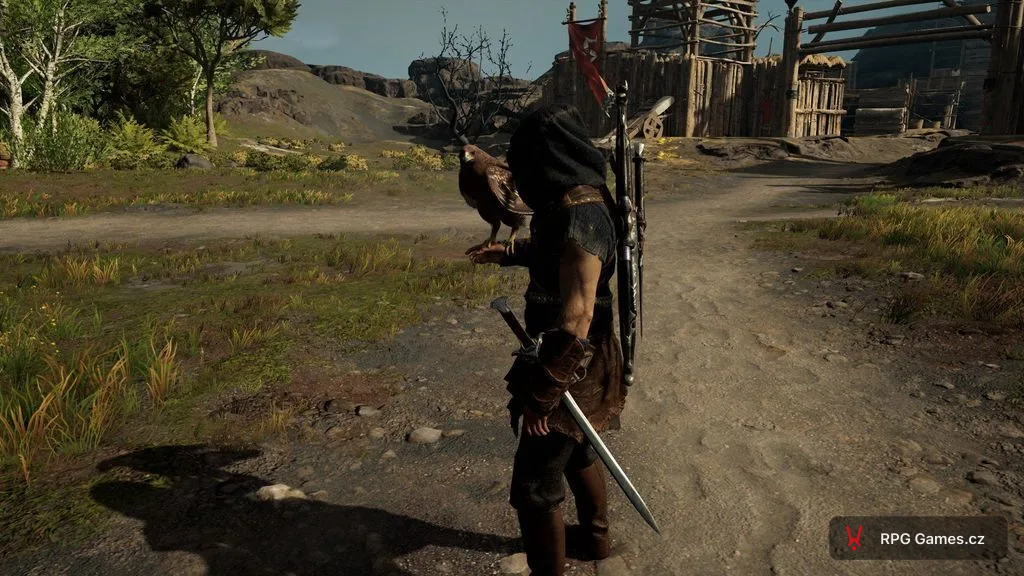
The main enemy is the Cult of Kosmos. A secret organization pulls the strings of the Peloponnesian War and reaches into your family too. Sibling Deimos grew up as their weapon.
You as a misthios hunt the cult across all of Greece. Masked members hide among politicians, soldiers, and merchants. Bit by bit you uncover their network and weaken their influence.
The goal of the game is clear. Break the Cult of Kosmos, find family, and decide who among those close to you survives.
Choices, endings, and consequences
Choices are more limited than the map and the dialogues suggest. The most important decisions revolve around family. With the Wolf of Sparta you decide whether you kill Nikolaos or spare him. Later you deal with sibling Deimos and whether they can be saved from the cult’s influence.
The ending of the game follows from that. Myrrine can stay or leave you. Stentor, Nikolaos’s adopted son from the time after you left, joins the family table by your choices, or stays against you. The best family ending requires sparing key characters and keeping promises toward Deimos.
Conquest battles between Sparta and Athens change who controls a region and what you earn from a fortress. In the finale none of that follows. The ending of the game mainly reads what you did with Nikolaos, Deimos, Myrrine, and Stentor.
Character
At the start you pick Kassandra or Alexios. Both are misthioi from a broken Spartan family, both carry the Spear of Leonidas, and both go through the same main line. Voice, animation, and performance differ. Game systems and quests stay the same.
Kassandra is Ubisoft’s official canonical choice. Alexios is an equally full playthrough. The character grows from a mercenary on Kephallonia into a hero who decides about the cult and about family. In combat you tune hunter, warrior, and assassin abilities by your style.
Friends and companions
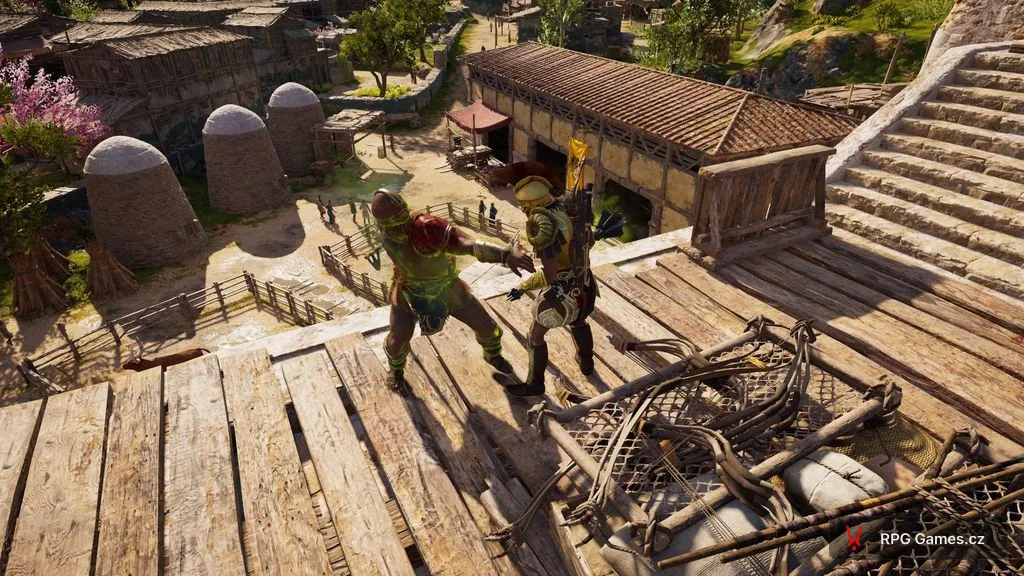
Odyssey builds a crew on the ship and friends who return in the story. Depending on how it goes, family can join at the end too.
Brasidas is a Spartan commander you fight with in key campaigns. He holds the war line and gives Sparta a human face. Myrrine is a mother and a political force. After the reunion she pulls you into decisions about citizenship, Deimos, and what of the family you can still save. Stentor is Nikolaos’s adopted son from the time after your fall from Mount Taygetos. He is a rival and a potential brother at the table, depending on how you handle the Wolf of Sparta.
On the ship Adrestia two stay constant. Barnabas is the captain who gets you from Kephallonia into the world and holds the crew together. Herodotos writes history, opens the door to Perikles, and holds an intellectual counterweight to Barnabas’s stories. You fill out the crew by hiring people from ports. They then fight in naval battles and give the ship character.
Romance arcs in the base game are more quick flings. In the DLC the relationships deepen and get more space.
Game systems
You fight in real time from a third-person view. Up close you slash with a sword or another weapon, from range you shoot a bow, and when nobody sees you, you sneak and kill from behind. You put abilities into the Hunter, Warrior, and Assassin branches and fire them right in combat. Opponents have different styles and conquest battles push you into larger clashes. Details of the styles are in combat types.
You pick difficulty from several tiers. The higher you go, the more combat mistakes and level gaps punish you. Progress comes from quests, exploration, and fights. You put points into the ability tree and keep gear at the region’s level. When armor and weapons lag behind the area level, enemies in forts and camps kill you quickly in open combat.
The world is huge. Mainland, islands, and sea you link on foot, on horseback, and by ship. The map is full of icons, camps, and question marks. I describe regions and travel in the map of Greece. You upgrade armor and weapons at the blacksmith, you tune the ship in port, and abilities in the tree, so you keep pace with the area level.
How hard it plays
For me the game is optimally hard. You can pick from several difficulty tiers. In this game the game forces you to do side tasks and map exploration too. Main tasks are not enough.
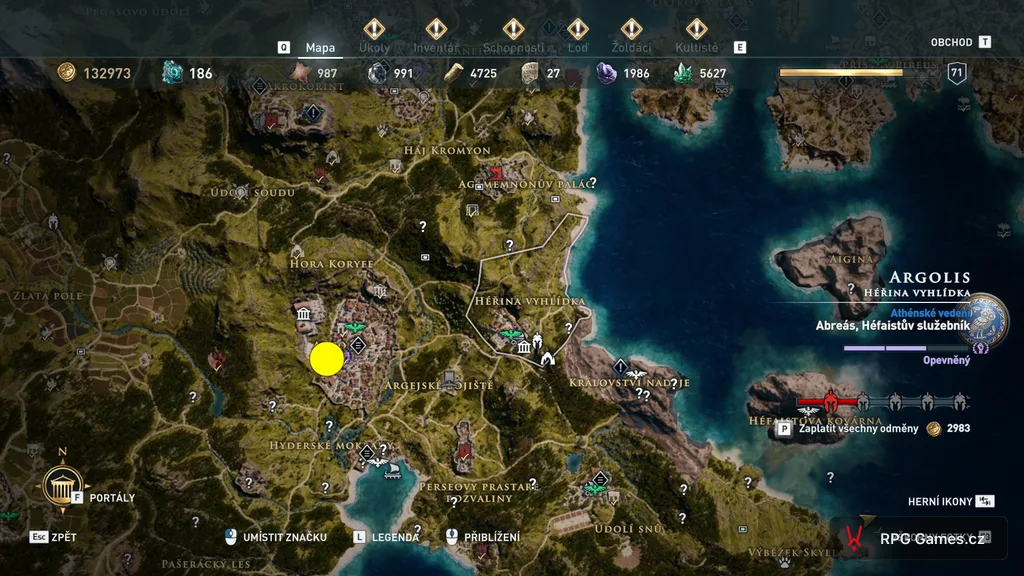
At the same time the game kept the logic from earlier Assassin titles. A mega large map with a pile of question marks is the largest I know. Clearing maps here is quite dull.
Graphics
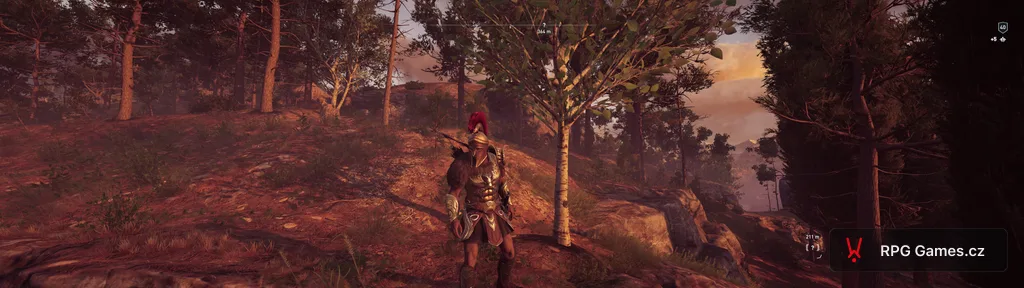
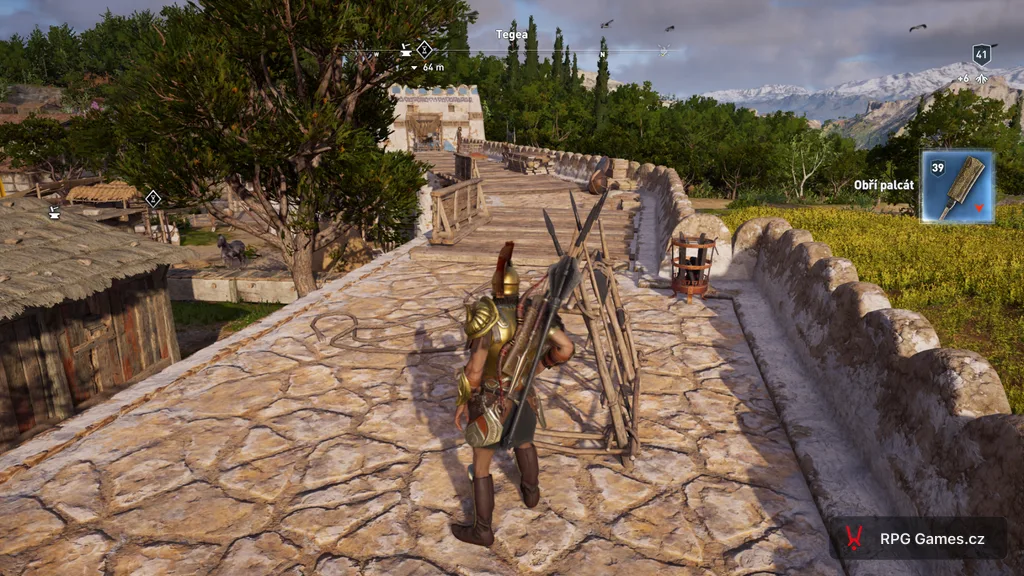
Odyssey runs on AnvilNext 2.0 and came out in 2018. The team went on location to Sparta, Delphi, Olympia, and Athens, photographed thousands of references, and deliberately refused a gray “cinematic” ancient Greece. Each region has its own colors and character, islands and mainland differ at first glance.
The sea makes up a large part of the map. From the mainland you go straight onto the ship and naval battles rank among the nicest passages in the series. Athens, mountain slopes, and the coast still hold up. Characters and animations fit the year of release and on today’s setups they do not offend.
Music and sound
The music was composed by the duo The Flight (Joe Henson and Alexis Smith) with a contribution from Mike Georgiades. The soundtrack mixes ancient instruments with modern epic. Regional themes, combat tracks, and quieter passages at sea hold the tone of a journey across Greece.
Weapon, wave, and battle sounds fit the action pace. English voice acting holds the characters. Alexios and Kassandra have performances that carry dozens of hours of dialogue. After finishing, what stays in my head most are the motifs from sailing and the big combat scenes.
Localization and language
Official Czech voiceover is missing. The game offers English voice acting and official Czech subtitles including a Czech menu. It plays well with them. Character and quest names fit and the texts are readable even in dense dialogues.
How to turn subtitles on in Steam and in the game I describe in the guide Czech language and subtitles. For a Czech player without English it is a comfortable path. Full voiceover simply is not here.
Pros and cons
What works
- Character — the protagonist is confident and likeable, it is good to play as them
- Combat — abilities, different opponents, and conquest battles keep you at the game for hours
- Greece — islands, sea, and naval battles still look great years later
- Friends and crew — Brasidas, Myrrine, Stentor, Barnabas, and Herodotos accompany you in the story
- Difficulty — the tiers fit and the game forces you through regions, not just the main line
- Czech language — official subtitles and menu work without a mod
What grates
- Story — it is shorter and predictable next to the size of the map
- Choices — family decides, Sparta vs Athens in the finale barely changes anything
- Map — a huge amount of question marks and camps is dull to clear
- Romance — in the base game they are more quick flings, they get more depth only in DLC
- Voiceover — Czech subtitles are there, Czech voiceover is missing
Expansions and DLC
Legacy of the First Blade is the first big story arc. You meet Darius, the first known bearer of the hidden blade, and you fight the Order of the Ancients. The DLC explains where the Assassin logic and hidden weapons in the series came from. Romance and personal relationships get more space here than in the base game.
The Fate of Atlantis is the second big arc in three episodes. It adds new maps of Elysium, the Underworld, and Atlantis. You play simulations from the Isu Aletheia and you learn to wield the Staff of Hermes Trismegistus. In Elysium Persephone rules and controls the whole paradise. In the Underworld you try to outwit Hades and you help lost souls. In Atlantis Poseidon names you judge of a city where Isu and humans live side by side. Along the way you unlock stronger abilities.
Both DLC make sense after the main line. The Season Pass is a practical path when you want both arcs at once.
Hardware requirements
Odyssey is moderately demanding on today’s PCs. The official Steam minimum holds a GTX 660 or R9 285, 8 GB RAM, and 46 GB of space. The recommended setup aims at a GTX 970 or R9 290 at Full HD. More detailed tables and FPS are in hardware requirements.
| Minimum | Recommended | |
|---|---|---|
| OS | Windows 10 64-bit | Windows 10 64-bit |
| CPU | Intel Core i5-2400 / AMD FX-6300 / AMD Ryzen 3 1200 | Intel Core i7-3770 / AMD FX-8350 / AMD Ryzen 5 1400 |
| GPU | NVIDIA GTX 660 / AMD R9 285 | NVIDIA GTX 970 / AMD R9 290 |
| Memory | 8 GB | 8 GB |
| Disk space | 46 GB | 46 GB |
On a modern PC the game runs smoothly. Naval battles and fortress conquests load the PC the most. When something crashes or stutters, the steps are at known issues.
Who I recommend it to
You can get Assassin’s Creed Odyssey on sale today well under the original price. The base game is enough for a first big playthrough. The Season Pass pays off when you want Legacy of the First Blade and Fate of Atlantis.
I recommend
- RPG fans who want a catchy story and a huge ancient world
- Players who love action combat with abilities, different opponents, and conquest battles
- Anyone interested in Isu mythology, Elysium, the Underworld, and Atlantis in the DLC
- Players who can handle English voice acting with official Czech subtitles
I do not recommend
- A play style of “finish 100 %, clear every point and go through every camp”, because that is dull
- Seekers of deep choices where every Sparta vs Athens battle changes the finale
- Anyone who wants full Czech voiceover
Verdict
Assassin’s Creed Odyssey is still a strong action RPG years later. After more than 300 hours I come back to it for Alexios, combat, and Greece. The story is shorter and predictable. Choices around Sparta and Athens in the finale disappoint. Character, combat, and the world balance that out though.
If you want an RPG and action fights, go for it. If you want to clear every icon on the map, save yourself the time and nerves. Where the game sits in my ranking is on the game ranking. Everything on the title is on the Assassin’s Creed Odyssey hub.
Časté dotazy
Is Assassin's Creed Odyssey worth it in 2026?
Yes, if you like action RPGs with an open world and a huge map does not bother you. The story is catchy, the character is top, and combat with conquest battles pulls you in. One hundred percent of the map and every camp is dull. After more than 300 hours I still recommend the game to RPG fans.
How long is Assassin's Creed Odyssey?
The whole story so that you keep up with leveling takes roughly 40 to 60 hours. With map cleanup, naval battles, and DLC it easily goes over a hundred hours. I have over 300 hours.
Play as Alexios or as Kassandra?
Both have the same story and the same abilities. Voice and performance differ. I mostly play as Alexios. Kassandra is Ubisoft's official canonical choice, but it does not change the playthrough.
Does Assassin's Creed Odyssey have Czech?
Official Czech subtitles and Czech menu yes, full Czech voiceover no. It plays well with subtitles. How to turn them on is in the Czech language and subtitles guide.
Which DLC should I buy?
Legacy of the First Blade explains the hidden blade and the Order of the Ancients. The Fate of Atlantis adds Elysium, the Underworld, and Atlantis, and lore around the Isu. The Season Pass makes sense when you want both story arcs.